
Should Students Do Music or Sports?
Should students do music or sports? I wish I were asked this question more often. Why?
Because it is a straightforward question. Which activity has more merit, benefit, or impact
on every student – music or sport?
As a music teacher, you may have already shaken your head and said, “sport”. This might not be what you personally believe, but it may be the most likely answer. With limited time in the school day to give to an activity, the benefits of sport may well outweigh the benefits of music learning.
The reasons could be social, cultural, resource-based, or historical, but in most schools, sports and music are perceived, timetabled, and esteemed very differently.
The either/or approach
The first question for me is, why does it need to be an either/or proposition? Why should we make students choose, or choose for them, between music learning and sports learning? The answer is, a lot of the time, we don’t make them decide at the start of their schooling experience. They get to do both music and sports learning as a regular part of their everyday education.
At what age does it become an either/or proposition? Or is it at what level of either sport or music?
Is the choice between music and sport influenced more by resources, cost, or availability of experienced and qualified staff, or more by underlying values and school or personal status?
Or is it all about choice – students who like music should do music, and students who like sports should do sports. And what happens to students who like music and sport?
I often find that the more questions I can pose about a given situation, the more complex that situation is. This is because I have to first acknowledge my own natural bias. I am a music teacher, and I think all students should learn music, and if they get to learn a sport, well, that is just a bonus. Now let’s flip that one around – I am a sports coach, and I think all students should learn a sport, and if they get music on the side, then that is just a bonus.
Did you nod your head at the sports coach's statement but feel a bit uncomfortable about the music teacher's statement? Should music learning be prized above sport, or is it that we, as music teachers, think and feel that the scales are heavily weighted against music learning, favouring sport?
Whenever I feel like something is very one-sided, I try to flip it around and see it from the opposite perspective. From an educational perspective, do I really think that my students should be actively discouraged from doing sport because it is less valuable to their development than music?
Can we compare the benefits of music and sport?
I am deliberately poking some pretty painful buttons. Still, educational values and more recent research point to the idea that sport and music could benefit cognitive development through a common process and not a competitive one.
A common argument that may favour sport over music is that it develops skills like teamwork, skill development, and physical coordination, predominantly through group activity in a school context, where everyone can participate. The kicker to this argument is the benefits to cardio and respiratory health, which can be directly connected to future health for the students.
It is difficult to argue against these benefits when comparing the benefits of music learning. While the benefits of music learning can be easily mapped against the sport benefits of “teamwork, skill development and physical coordination, predominantly through group activity in a school context, where everyone can participate”, I am not sure it is as easy to map across the cardio and respiratory health benefits. It is not as straight or simple as a line between the two, and when it comes to benefits, physical health is a big one.
A new way to look at music and sport
What if music learning could benefit sport, and sport could benefit music learning? In a fascinating paper titled “Exercise, Sports, and Performance Arts Benefit Cognition via a Common Process”, Tomporowski and Pesce, academics at the Department of Kinesiology, University of Georgia, suggest that academics in the exercise, sport, and arts areas are all looking at how their activity develops cognitive skills, especially executive functions.
They found that they are discovering many of the same benefits, but they haven’t shared their research to compare and strengthen their understanding of human cognitive development in general.
If researchers from different fields, such as music and sport, came together to compare, for example, how skills acquisition in sport and technique development in music impact global brain skills such as executive functions, then Tomporowski and Pesce suggest we may no longer see a competition between the two activities, but how they could potentially complement each other. This idea is not a new one. When it comes to music and language learning, discovering the overlapping neural network that both language and music utilise has led to language and music academics working together.
Mapping music executive function development across sport
Let’s flip the description of how music learning develops executive functions across to sport. In a study of executive functions in children aged 4-12 years old, Diamond and Lee found that “Learning music involves all the aspects that account for an effective training of executive functions.”
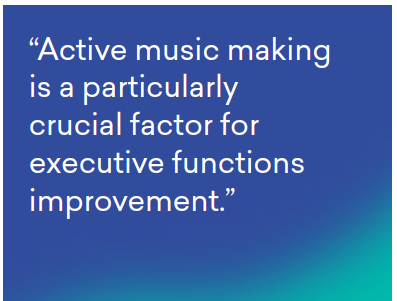
1. Building on this research, in a new paper by three researchers at Justus-Liebig-University Giessen in Germany, they found that “instrumental music training is highly likely to benefit executive function development in children.”
2. They went further by describing how music learning enhances executive functions.
Inhibition skills are required when the key or the beat changes, and the musician needs to suppress the urge to stay in the prior key or rhythm.
Selective attention is necessary when the musician listens carefully to the sound of another player during ensemble playing. Auditory and visual working memory, as well as short-term memory, are required while remembering musical passages.
Long-term memory is involved when musical pieces are played by heart.
Cognitive flexibility is required when shifting between different musical instructions.
Could we similarly map how these skills are developed in sport?
Inhibition skills are required when the ball direction or the tempo of play changes, and the sports players need to suppress the urge to keep travelling in the prior direction or speed.
We could take the example of the overlapping neural network between music and language and apply it to music and sport in terms of executive function. When students enhance the symbol-to-sound system for reading music, they also enhance the phonological loop for reading language. The symbol-to-sound system and the phonological loop are the same pathways in the brain, but by using the same pathways for two quite different activities, the pathway gets wider, faster, and more reliable.
Could we look at music and sport as different activities that widen and enhance the executive function skills pathways, making it possible and preferable for every student to do music and sport to enhance their ability to learn?
Read More
Diamond, A., & Lee, K. (2011). Interventions shown to aid executive function development in children 4 to 12 years old. Science (New York, N.Y.).
Frischen, U., Schwarzer, G., & Degé, F. (2021). Music lessons enhance executive functions in 6-to 7-year-old children. Learning and Instruction.
Tomporowski, P. D., & Pesce, C. (2019). Exercise, sports, and performance arts benefit cognition via a common process. Psychological Bulletin.
More Research to Follow
Phillip Tomporowski, Professor of Kinesiology, University of Georgia
Article Credits
"Thank you" to Anita Collins' Bigger Better Brain Foundation for this enlightening article.
Frischen, U., Schwarzor, Q. & Dogo, F. [202% Music lessons enhance executive function in 6-7 year old children for Learning and Instruction.
Get to know Rebecca's heart from the different topics she writes about, including the story behind the songs she writes, short Bible teachings as a grandma sharing her toolbelt from heaven, biblical grieving from her firsthand experiences, and why music lessons are so beneficial for developing children, overcoming trauma, and retaining vocal and mental agility as an adult.
info@rebeccaalderman.com
Your Periodic Update
Subscribe now to get periodic updates.